Quickstart
A 1-D k-eigenvalue problem
A bare uranium sphere of radius 100 cm, one energy group, zero flux at the surface:
import numpy as np
import ndiffusion as nd

m = nd.Materials()
m.n_mat    = 1
m.n_groups = 1
m.D        = [3.850204978408833]
m.removal  = [0.1532]
m.scatter  = [0.0]
m.chi      = [1.0]
m.nusigf   = [0.1570]

cells = 50
edges = np.linspace(0.0, 100.0, cells + 1)

solver = nd.KEigenSolver(
    mats       = m,
    medium_map = [0] * cells,
    edges_x    = edges,
    geom       = nd.Geometry.Sphere,
    bc         = [nd.BoundaryCondition(A=1.0, B=0.0)],
    epsilon    = 1e-8,
    max_outer  = 500,
)
result = solver.solve()
assert result.converged
print(f"keff = {result.keff:.8f}")   # -> 1.00000475
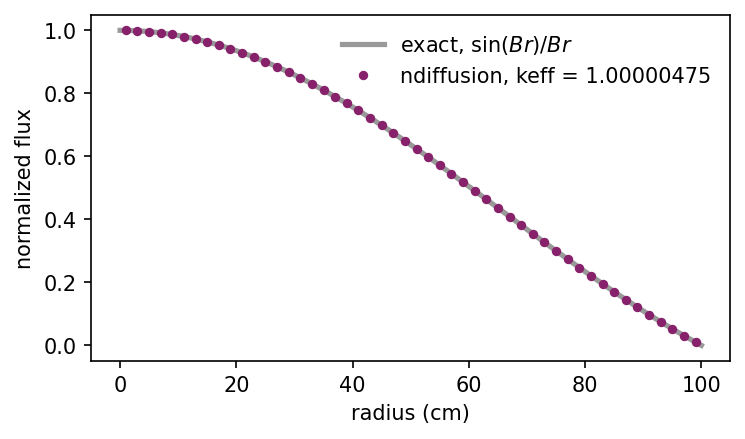
medium_map gives the material index of each cell, edges_x the cell edges, and
bc the boundary condition on the outer edge, one per energy group. The center
of a sphere is a symmetry point, so nothing is needed there.
Arrays in and out
Inputs take any array-like, so lists work too. result.flux comes back as a
numpy array of shape (n_cells, n_groups). Per-cell inputs - a fixed source, an
initial flux - take the same (n_cells, n_groups) shape or the flat row-major
equivalent, flux[cell * n_groups + g]. A transposed array has the right size
but the wrong layout, so it is rejected rather than silently scrambled.
Convergence
Every result carries a converged flag. A solve that stops at its iteration cap
returns the last iterate and issues an ndiffusion.ConvergenceWarning, which the
standard warnings filters control - for example, to make it an exception:
import warnings
warnings.simplefilter("error", nd.ConvergenceWarning)
A long solve can be stopped with Ctrl-C; the solvers check for interrupts once per outer iteration.
A 2-D structured problem
A square of the same material, R cm on a side, with vacuum on the right and
top edges. The left and bottom edges default to reflective, so this is one
quarter of a 2R x 2R core:
R, nx, ny = 100.0, 40, 40

solver = nd.KEigenSolver2D(
    mats       = m,
    medium_map = [0] * (nx * ny),
    edges_x    = np.linspace(0.0, R, nx + 1),
    edges_y    = np.linspace(0.0, R, ny + 1),
    geom       = nd.Geometry2D.XY,
    bc_x       = [nd.BoundaryCondition(A=1.0, B=0.0)],   # vacuum right
    bc_y       = [nd.BoundaryCondition(A=1.0, B=0.0)],   # vacuum top
    max_outer  = 500,
)
result = solver.solve()
flux = result.flux.reshape(nx, ny, m.n_groups)   # row i * ny + j is cell (i, j)
An unstructured fixed-source problem
ndiffusion.layouts builds common core geometries as an UnstructuredMesh2D.
Here a quarter of a 100 cm square core with a uniform source, using a two-group
material set:
from ndiffusion import layouts

mats = nd.materials.two_group([
    # D1,  D2,   Sa1,   Sa2,  S12,  nuSf1, nuSf2
    (1.4, 0.4, 0.010, 0.080, 0.02, 0.000, 0.000),
])
mesh = layouts.cartesian_mesh(width=100.0, h=2.5, orientation="quarter")
bc = layouts.boundary_conditions(mesh, D=[1.4, 0.4], albedo=0.0)

solver = nd.FixedSourceSolverUnstructured2D(mats, mesh, bc, epsilon=1e-10,
                                            max_inner=5000, omega=1.9)
source = np.zeros((solver.n_cells, 2))
source[:, 0] = 1.0                       # fast source, per unit volume
result = solver.solve(source)
omega is the over-relaxation factor of the point SOR sweep; omega = 1 is
plain Gauss-Seidel.
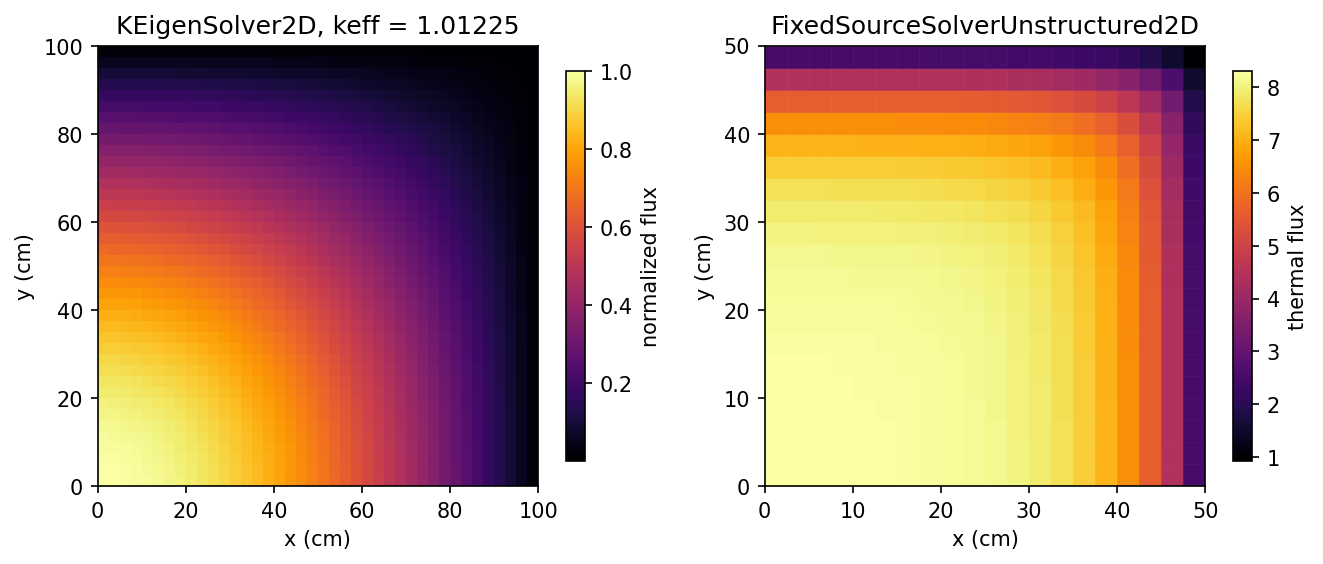
The flux from the two 2-D problems:
Next steps
Geometry and meshes covers meshes, material maps and layouts.
Cross sections covers cross sections, including the published benchmark tables.
The Examples are runnable scripts with plots, one per topic.