Note
Go to the end to download the full example code.
k-eigenvalue problems in 1-D
Two spheres: a bare one-group sphere at its critical radius, and a two-group sphere with a reflective surface, which is the infinite medium. Both have an analytic eigenvalue to check against.
Run after installing the package:
pip install .
python examples/k_eigenvalue.py
import matplotlib.pyplot as plt
import numpy as np
from _plotting import plot_groups

import ndiffusion as nd
One group, bare sphere
With zero flux at the surface the critical radius is \(R = \pi / B\), where \(B^2 = (\nu\Sigma_f - \Sigma_a) / D\). These cross sections put it at 100 cm, so the exact eigenvalue is 1.
m = nd.Materials()
m.n_mat    = 1
m.n_groups = 1
m.D        = [3.850204978408833]
m.removal  = [0.1532]
m.scatter  = [0.0]
m.chi      = [1.0]
m.nusigf   = [0.1570]

cells = 50
edges = np.linspace(0.0, 100.0, cells + 1)

solver = nd.KEigenSolver(
    mats       = m,
    medium_map = [0] * cells,
    edges_x    = edges,
    geom       = nd.Geometry.Sphere,
    bc         = [nd.BoundaryCondition(A=1.0, B=0.0)],
    epsilon    = 1e-8,
    max_outer  = 1000,
)
result = solver.solve()

print(f"keff       = {result.keff:.8f}  (exact: 1)")
print(f"iterations = {result.iterations}")
print(f"residual   = {result.residual:.2e}")
keff       = 1.00000475  (exact: 1)
iterations = 215
residual   = 9.76e-09
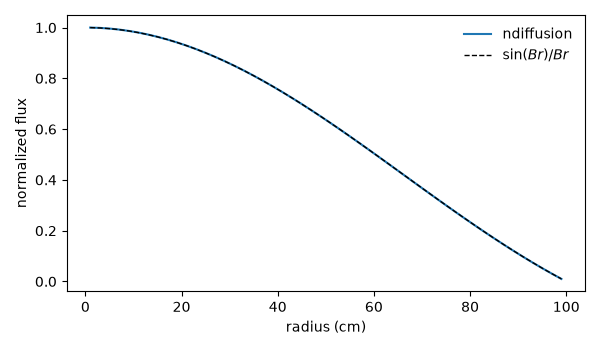
The fundamental mode of a bare sphere is \(\sin(Br) / r\).
r = 0.5 * (edges[:-1] + edges[1:])
B = np.pi / 100.0
exact = np.sin(B * r) / (B * r)

fig, ax = plt.subplots(figsize=(6, 3.5))
plot_groups(ax, edges, result.flux, labels=["ndiffusion"])
ax.plot(r, exact, "k--", lw=1, label=r"$\sin(Br)/Br$")
ax.set_xlabel("radius (cm)")
ax.legend(frameon=False)
fig.tight_layout()
Two groups, infinite medium
A reflective surface removes all leakage, so the eigenvalue is
\(k_\infty = (\nu\Sigma_{f,1} + \nu\Sigma_{f,2}\,\Sigma_{1\to2} /
\Sigma_{r,2}) / \Sigma_{r,1}\). Scatter is indexed [g_to][g_from], so the
fast-to-thermal transfer is the second row, first column.
m2 = nd.Materials()
m2.n_mat    = 1
m2.n_groups = 2
m2.D        = [0.1, 0.1]
m2.removal  = [0.0362, 0.121]
m2.scatter  = [0.0,    0.0,
               0.0241, 0.0]
m2.chi      = [1.0, 0.0]
m2.nusigf   = [0.0085, 0.185]

reflective = nd.BoundaryCondition(A=0.0, B=1.0)
solver2 = nd.KEigenSolver(
    mats       = m2,
    medium_map = [0] * 50,
    edges_x    = np.linspace(0.0, 5.0, 51),
    geom       = nd.Geometry.Sphere,
    bc         = [reflective, reflective],
    epsilon    = 1e-8,
)
result2 = solver2.solve()

k_inf = (0.0085 + 0.185 * 0.0241 / 0.121) / 0.0362
print(f"keff  = {result2.keff:.8f}")
print(f"k_inf = {k_inf:.8f}")
keff  = 1.25268253
k_inf = 1.25268253
Without leakage the flux is flat, and its group ratio is the infinite-medium spectrum \(\phi_2 / \phi_1 = \Sigma_{1\to2} / \Sigma_{r,2}\).
flux2 = result2.flux
print(f"thermal/fast = {flux2[:, 1].mean() / flux2[:, 0].mean():.6f}"
      f"  (expected {0.0241 / 0.121:.6f})")

plt.show()
thermal/fast = 0.199174 (expected 0.199174)
Total running time of the script: (0 minutes 0.145 seconds)