
Machine learning for nuclear data reduction
Multigroup discrete ordinates calculations need fission and scattering cross section matrices for every material, temperature, and enrichment level. With hundreds of energy groups, storing those matrices becomes a limiting factor.
Approach
Instead of storing the matrices, I train models that reproduce the function mapping the scalar flux to the scattering and fission sources. The models are built from autoencoders and Deep Jointly-Informed Neural Networks (DJINN).
Results
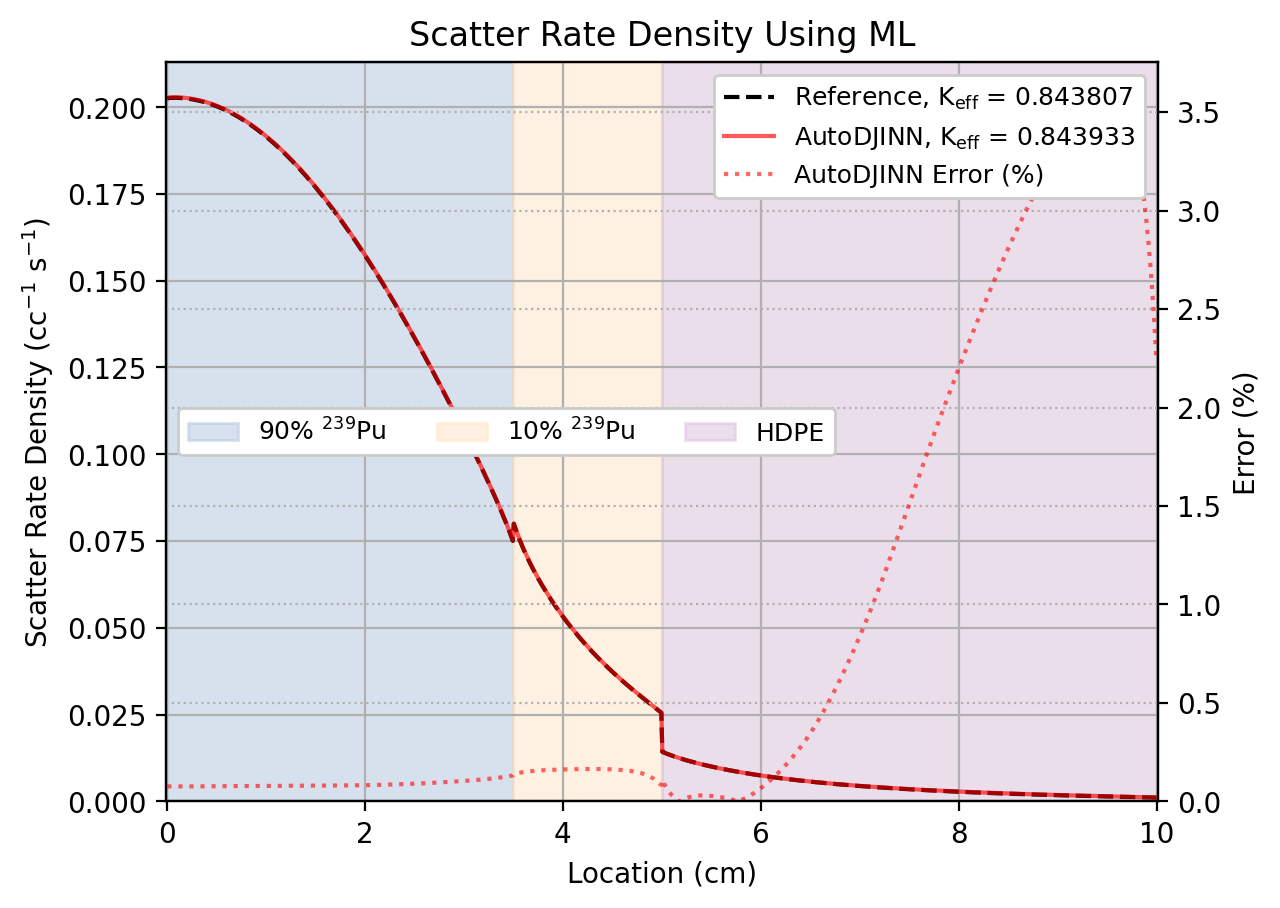
For a 618-group problem, the models cut data storage by 94% while preserving the scalar flux, staying general, and reducing wall-clock time.
Publications
- Data Reduction in Deterministic Neutron Transport Calculations Using Machine Learning. Ben Whewell and Ryan G. McClarren, (2022). Annals of Nuclear Energy, 176, p. 109276. DOI: 10.1016/j.anucene.2022.109276
- Reduced Models for Nuclear Data in Transport Equations. B. Whewell and Ryan G. McClarren, (2021). The International Conference on Mathematics and Computational Methods Applied to Nuclear Science and Engineering, p. 1427-1436.
- Applying Autoencoders for Data Reduction of Neutron Scattering Matrices. Ben Whewell and Ryan G. McClarren, (2020). Conference on Data Analysis. Poster Presentation.
Code
The DJINN models are available as an option in discrete1, using my maintained fork of DJINN.